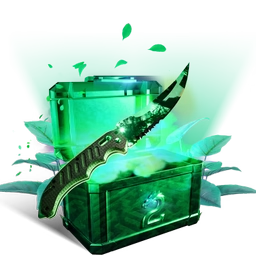
Unlocking Success: The Art of CS2 Case Opening
Few features in modern gaming have captivated players quite like the weapon case system in Counter-Strike: Global Offensive (and its successor, Counter-Strike 2). What started as a cosmetic addition in 2013 has evolved into a multi-million-dollar virtual economy, drawing comparisons to stock markets and casinos alike.
Whether one is a veteran player looking to cash out or a curious newcomer wondering why a digital pixel knife can cost thousands of dollars, understanding how CS:GO cases work is essential. This guide dives deep into the mechanics, probabilities, and economics behind the game’s most famous feature.
What Are CS:GO Cases?
CS:GO cases are virtual containers that hold weapon skins, gloves, and knives. To open a case, a player needs two things:
- The Case Itself: Dropped randomly during gameplay, received via weekly care packages, or purchased from the Steam Community Market.
- A Key: Purchased strictly in-game (or via the Steam store) for a flat rate of £2.50 GBP.
Once opened, the case treats the player to a roulette-style animation where a ticker slows down across various tiers of weapon finishes before landing on a single item.
Understanding Item Rarities and Drop Rates
The allure of CS:GO cases lies in the rarity of their contents. Valve has never officially published exact percentage drop rates for every individual item, but community-driven data collection—analyzing millions of unboxings—has provided a clear picture of the probabilities involved.
Estimated Case Drop Probabilities
| Rarity Tier | Item Type | Estimated Drop Rate |
|---|---|---|
| Consumer Grade | Base / White | 0% (Cases do not contain these) |
| Mil-Spec | Blue Skins | ~79.92% |
| Restricted | Purple Skins | ~15.98% |
| Classified | Pink Skins | ~3.20% |
| Covert | Red Skins (High-tier) | ~0.64% |
| Exceedingly Rare | Knives / Special Gloves | ~0.26% |
As the table shows, the odds of unboxing a rare knife or set of gloves are roughly 1 in 385. This low probability is precisely what drives the high market value of top-tier items.
The Economics of Unboxing: StatTrak and Wear
Beyond base rarity, two major factors influence the value of an unboxed item: Wear Condition and StatTrak Technology.
1. Wear Conditions (Float Values)
Every weapon skin is assigned a float value ranging from 0.00 to 1.00, which dictates its physical condition in-game.
- Factory New (0.00 – 0.07)
- Minimal Wear (0.07 – 0.15)
- Field-Tested (0.15 – 0.38)
- Well-Worn (0.38 – 0.44)
- Battle-Scarred (0.44 – 1.00)
Note: Some skins are capped and cannot drop in Factory New condition.
2. StatTrak
Any weapon pulled from a case has a roughly 10% chance of being a StatTrak variant. These weapons feature a small digital counter that tracks the number of kills made with that specific gun in competitive matches. StatTrak variants generally command a higher price on the marketplace.
The Steam Community Market and Third-Party Trading
Because players can freely buy, sell, and trade their case drops and unboxed skins, a robust player-driven economy was born.
- The Steam Community Market: The official platform where players buy and sell items using Steam Wallet funds. Valve takes a transaction fee (roughly 15%) on every sale.
- Third-Party Marketplaces: External websites allow players to buy skins using real-world fiat currency or cryptocurrencies, or to trade items directly peer-to-peer.
Why Do Some Cases Cost So Much?
Not all cases are created equal. Active-drop cases (those currently dropping to players playing the game) usually cost just a few cents. However, discontinued or rare drop pool cases can cost anywhere from £1 to over £100 per case.
Factors driving case prices include:
- Discontinuation: Once Valve stops dropping a case regularly, supply dwindles while demand remains steady or grows.
- Desirable Contents: Cases containing legendary knives (like the Karambit or Butterfly Knife) or iconic skins (like the AWP | Asiimov) retain higher long-term value.
Tips for Navigating the Case Economy
For those thinking about diving into the world of CS:GO cases, keep these best practices in mind:
- Treat it as Entertainment, Not Investment: Mathematically, the expected return on opening a case is significantly lower than the £2.50 key cost. Most unboxings result in items worth pennies.
- Buy Singles Instead: If a specific skin is desired, it is almost always cheaper to buy it directly from the Community Market than to try and unbox it.
- Understand the Market Risks: Treating virtual items as financial investments carries risk. Valve can—and does—patch game mechanics, update lighting, or alter economies, which can drastically shift skin prices overnight.
Frequently Asked Questions (FAQ)
Can I still open CS:GO cases in Counter-Strike 2?
Yes. All CS:GO cases, keys, and weapon skins transferred over seamlessly to Counter-Strike 2. The case-opening animation and mechanics remain fundamentally the same.
Are CS:GO cases considered gambling?
Legally, this varies by country. Because items won from cases have real-world monetary value via third-party marketplaces (and Steam Wallet funds can sometimes be cashed out), many governments and regulatory bodies view loot boxes and cases as a form of gambling. Several countries have restricted or outright banned loot box mechanics.
What is the rarest skin you can unbox?
While factory-new covert skins are extremely rare, the absolute rarest items are knives and gloves with specific patterns and exceptionally low float values—such as a Factory New StatTrak Karambit Crimson Web or Blue Gem case-hardened knives, which have commanded hundreds of thousands of dollars in private trades.
How do I get free cases?
Players typically receive cases as drops by playing on official servers. You are usually limited to a maximum of 1–2 case drops per week, reset every Wednesday alongside the weekly care package update. Prime Status is usually required to be eligible for drops.
Browse CS2 skin designs and learn how a CSGO Case shapes your inventory, from coveted rare drops to colorful weapon finishes.